


Choosing Glass or Acrylic for Your Magic Mirror
If you’re planning on building your own Magic Mirror, the material you use plays an important part in how your Magic Mirror looks. Different styles and types of Magic Mirrors require different materials and some materials are more expensive than others.
You have two options with your Magic Mirror: glass or acrylic. Glass is more expensive than acrylic, but can give better results. Acrylic can flex and slightly distort the reflected image, which may be unnoticeable on small Magic Mirrors, but a disaster on large bathroom-sized mirrors.
The right option for you depends on your budget, the size of the Magic Mirror you want to build, and the style of your mirror.
Let’s look closer at the different options you have so you can make the right choice for your Magic Mirror.
Glass vs Acrylic: Cost
The amount of money you want to spend on your Magic Mirror might tell you which material to use. As I cover in my article on the costs of building a Magic Mirror, there can be a massive difference in cost between a glass Magic Mirror and an acrylic Magic Mirror.
There are also two different options for glass. The most expensive option is to buy a pane of two-way glass. This is when the glass is manufactured with the reflective two-way film.
These two-way mirrors are incredibly expensive, but give the best possible quality for your Magic Mirror. The other option is to buy a regular pane of glass, then stick two-way film onto the glass.
It’s much cheaper to buy regular glass and add film to it, but the results won’t be as good as a proper two-way mirror.
Adding film to glass is a very good approach. Acrylic can produce too much distortion and may not look as good. Getting a proper two-way mirror manufactured is a much more expensive option.
So adding film to glass is a way you can get a good looking mirror at a reasonable cost.
Bottom line: acrylic will be cheaper than glass, but acrylic only looks good on small to medium sized Magic Mirrors. The larger your Magic Mirror, the more acrylic sheets will distort the reflected image. If you’re planning on building a large Magic Mirror, use glass.
If you’re planning a small to medium sized Magic Mirror, pick the best option that fits your budget.
Comparing Glass and Acrylic
If you’ve been searching on Google for examples that compare glass and acrylic Magic Mirrors, you’ve probably seen photos like this one:
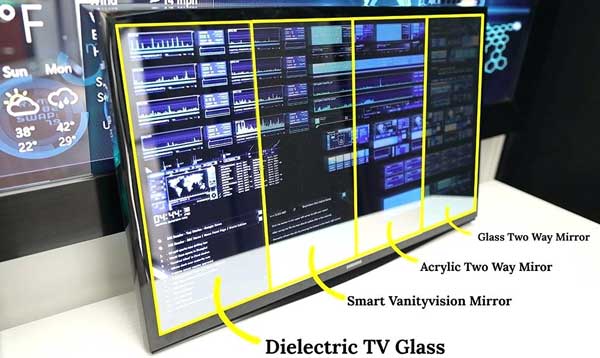
At first this type of direct comparison looks really helpful. You can clearly see there’s a big difference between some of the above panels. A quick glance at the above photo and it should be obvious which panel you should use for your Magic Mirror.
Glass looks terrible when compared to acrylic, which both look terrible against the other two options. But there’s a flaw in this type of comparison. The brightness of the display coming through the glass is only one part of a Magic Mirror. The other part is the reflection quality.
Can you tell from the above photo which panel gives you the best mirror-like finish? Not at all.
Be wary of these type of comparisons. The only places I’ve seen comparisons like this is from websites that sell ‘special’ panels designed for Magic Mirrors. It’s no surprise that their most expensive options always look the best in these comparisons.
These companies want to sell you their expensive proprietary materials, so of course they will make sure they look the best in comparisons.
While the above photo makes it look like there’s a huge difference between glass and acrylic, there’s actually very little difference between glass and acrylic. It’s not the material that makes the difference, it’s the reflective film.
The differences you see in the above photo (or similar comparison photos) are due to the different qualities of the reflective films used on the back of each panels. If the same film was used on all of those panels, the differences between them would suddenly disappear.
The above photo might be comparing a 70% reflective glass against a 50% reflective acrylic. In other words, not a fair comparison.
The point to take away here is that these type of comparisons are misleading. What might look like the best option in the above photo may be overkill for your Magic Mirror. The worst looking panel in the above photo might be perfectly fine for your needs.
Don’t be fooled by comparisons like the above photo.
Pros and Cons of Using Acrylic For Your Magic Mirror
The obvious benefit, as mentioned above, is that acrylic is cheap and easy to use. You can easily buy a sheet of two-way acrylic, slap it in a frame and mount your display.
You can even cut acrylic sheets fairly easily to get the perfect size for your Magic Mirror.
Another benefit to using acrylic is the weight. Acrylic sheets will be far lighter than glass sheets. Glass will always be far heavier than acrylic.
A downside of using acrylic is when it comes to larger Magic Mirrors. Acrylic can warp and distort the reflected image. Even a slight pressure from the display or frame can be enough to turn your Magic Mirror into a fun-house mirror.
In smaller builds you may not notice any distortions at all. As the size becomes larger, distortions become far more noticeable. Using an acrylic sheet for a large bathroom mirror would end in disaster.
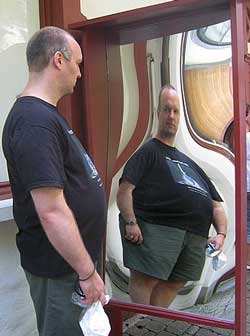
Another downside of using acrylic is if you want to build a borderless Magic Mirror. Acrylic sheets aren’t suitable for borderless Magic Mirrors. The edges will look terrible and trying to mount an acrylic sheet as a borderless mirror will create horrible distortions.
If you don’t plan on building a borderless Magic Mirror this won’t be a problem. But if you’re considering a borderless Magic Mirror, keep this in mind.
Bottom line: acrylic is cheaper and allows you to cut it to the exact size you require. The downside is it can warp or distort and doesn’t look good as large mirrors.
Pros and Cons of Using Glass For Your Magic Mirror
Glass Magic Mirrors can look amazing. When the display is off, they can look indistinguishable from normal mirrors. While you might not be able to notice any difference between a small glass Magic Mirror and a small acrylic Magic Mirror, the differences will become obvious with larger mirrors.
One of the reasons why glass Magic Mirrors can look so good is because of the strength of glass. Glass gives a nice flat surface that won’t warp or distort the reflected image. For large Magic Mirrors this is important as you will notice any warping.
A great benefit of glass is it gives you the option of going borderless.
A downside of using glass is the weight. Larger sheets of glass need to be produced thicker for added strength. Having a thicker sheet of glass can add a lot of weight.
Not only do you want to make sure you build a frame that can properly support that weight, but you need to be extra careful when mounting the mirror on the booth structure. The last thing you want is for a large sheet of glass to come crashing down on someone.
Bottom line: glass is strong and can give fantastic results when used for Magic Mirrors. Larger Magic Mirrors should use glass to avoid warping or distortions. The downside is glass is harder to work with, weighs more, and costs more.
Choosing The Right Material For Your Magic Mirror
If you’ve read through all of this article, you should have a good idea whether acrylic or glass better suits your needs.
Here are a few main points to help you decide which is best for your Magic Mirror:
- Smaller mirrors can use glass or acrylic without much difference in quality
- Medium sized mirrors tend to look better with glass, but acrylic can still look good if the frame is built properly
- Large Magic Mirrors look best when using glass
- Acrylic is far cheaper than glass and can be cut to size as you need
- Acrylic can warp and distort if any pressure is applied, so try to use a thick sheet
- Glass can add a lot of weight to your Magic Mirror, so be extra careful building your frame and mounts
- If you want a borderless Magic Mirror, use glass
Leave a Reply